How Can an AI Travel Agent Save You Money on Trips?
 Overfinite ·
 Travel planning has always been a game of information — who knows the cheapest flight window, the best hotel rate, the route that avoids the $40 taxi. For decades, that knowledge lived with experienced travel agents or buried inside forums most people never found. An AI travel agent changes that equation entirely, putting real-time pricing intelligence and personalised planning into a single tool available at any hour.
According to a November 2024 Statista survey, 40% of travellers globally now use an AI-based tool for travel planning — and the market is growing fast enough that this figure is likely already outdated. The shift isn’t just about convenience. It’s about the money travellers leave on the table by planning the old way.
What an AI Travel Agent Actually Does
The term gets used loosely, so it’s worth being specific. An AI travel agent is a planning tool that uses machine learning and natural language processing to analyse pricing data, travel patterns, and user preferences — then generates recommendations, itineraries, and booking strategies based on that analysis.
That’s meaningfully different from a search engine. A search engine returns results. An AI travel assistant interprets them — weighing your dates, budget, destination preferences, and past behaviour to produce an itinerary that fits your actual situation rather than a generic best-of list.

How It Differs from Traditional Search Tools
| Feature | Search Engine | AI Travel Agent |
| Price comparison | Shows results | Analyses and ranks by value |
| Itinerary building | Manual | Automated from preferences |
| Dynamic pricing alerts | None | Real-time monitoring |
| Personalization | Cookie-based | Preference-learned |
| Time investment | High | Low |
| Local knowledge | Surface-level | Deep, multi-source |
The practical result is a significant reduction in both time and cost — not through magic, but through the sheer volume of variables an AI can track simultaneously that a human planner simply cannot.
Where an AI Travel Agent Saves Real Money
Flight Pricing and Timing Optimisation
Flights are where most trip budgets either hold or collapse. Prices on the same route can vary by hundreds of dollars depending on the day of booking, the day of departure, the time of day, and dozens of other factors that shift constantly. An AI travel assistant monitors those variables continuously and identifies booking windows that human planners would miss.
AI applications are capable of reducing flight disruption costs by approximately 16%, equivalent to nearly $265 billion in global savings — a figure that reflects how significantly intelligent systems outperform manual booking approaches at scale. For individual travellers, the savings are smaller in absolute terms but proportionally just as meaningful.
Practically, this means:
- Booking day optimisation — identifying that Tuesday departures on a given route are historically cheaper than Friday ones
- Advance purchase windows — tracking the sweet spot between booking too early (prices drop later) and too late (availability narrows)
- Flexible date analysis — showing the cost differential across a range of travel dates when the traveller has flexibility
- Layover routing — identifying cheaper multi-stop routes that arrive within acceptable timeframes
Accommodation Matching Beyond the Obvious Options
Hotel search platforms show you what they’re paid to promote. An AI travel agent cross-references accommodation across multiple data sources, weighting price, location relative to the traveller’s actual itinerary, guest review patterns, and cancellation terms simultaneously.
This matters most when a trip involves multiple cities. For a five-stop European trip, the difference between accommodation that’s well-located for each day’s plans and accommodation chosen by star rating alone can add up to dozens of hours in transit time — which is its own form of budget waste.
If you’re planning something like a multi-stop Scandinavia circuit (the guide to places in Denmark beyond Copenhagen covers exactly this kind of regional itinerary), location optimisation makes a genuine difference to both the experience and the total cost.
AI Optimisation of Travel Packages
The concept of AI optimization travel applies particularly well to package holidays and multi-component bookings, where small changes in sequencing can yield significant price differences. Adjusting the order of destinations, swapping a direct flight for a same-day connection, or shifting an experience from a high-demand Saturday to a Thursday can each shave meaningful amounts from the total.
Most travellers don’t explore these permutations because doing it manually is exhausting. AI does it in seconds — and the best ai for travel planning tools surface the optimised version directly, without requiring the traveller to understand the mechanics behind it.

The Role of AI in Travel Personalisation
Price isn’t the only variable that saves money. A trip that doesn’t match what the traveller actually wants is its own form of waste — flights to a beach destination during peak monsoon season, a restaurant-heavy itinerary for someone who prefers markets and street food, a city hotel for someone who’d prefer a neighbourhood guesthouse.
AI in travel planning reduces mismatched trips by learning preferences across sessions. The more it’s used, the more accurately it anticipates what the traveller will value — which means fewer expensive mistakes and fewer paid activities that go unused.
62% of Gen Z travellers use AI specifically to help them save money on travel, and this group’s adoption rate suggests the behaviour will spread upward through other demographics as the tools improve. The savings aren’t theoretical — they’re being realised by a generation that has grown up treating AI as a default planning resource rather than a novelty.
The personalisation layer is also where AI outperforms both generic search engines and most human agents, who tend to default to familiar itineraries and established suppliers. An AI travel assistant surfaces options that sit outside the mainstream precisely because it’s working from data rather than habit. That’s how a traveller ends up eating at the best local restaurants in Sydney rather than the first harbourside name that comes up on TripAdvisor.
Practical Ways to Use an AI Travel Agent Effectively
Getting the most out of AI travel planning tools requires a slightly different approach than traditional search.
Before you start planning:
- Feed the AI your actual constraints — hard travel dates, budget ceiling, must-have versus nice-to-have experiences
- Be specific about preferences rather than leaving them vague; “I prefer boutique accommodation in walkable neighbourhoods” yields better results than “nice hotel”
- Specify how much flexibility exists on dates — even a two-day window opens significantly cheaper options on most routes
During itinerary building:
- Ask the AI to show price differentials across date ranges, not just the cheapest option
- Request alternative routing for any flight that feels expensive — there’s often a cheaper connection that adds minimal time
- Use the tool to cross-check accommodation location against each day’s actual itinerary rather than the city centre as default
For ongoing optimisation:
- Set price alerts on confirmed dates and monitor them through to departure — fares still move after booking and some airlines allow date changes at low cost
- Use the AI travel assistant to build local knowledge before arrival — the best experiences in any destination are rarely the ones with the biggest marketing budgets
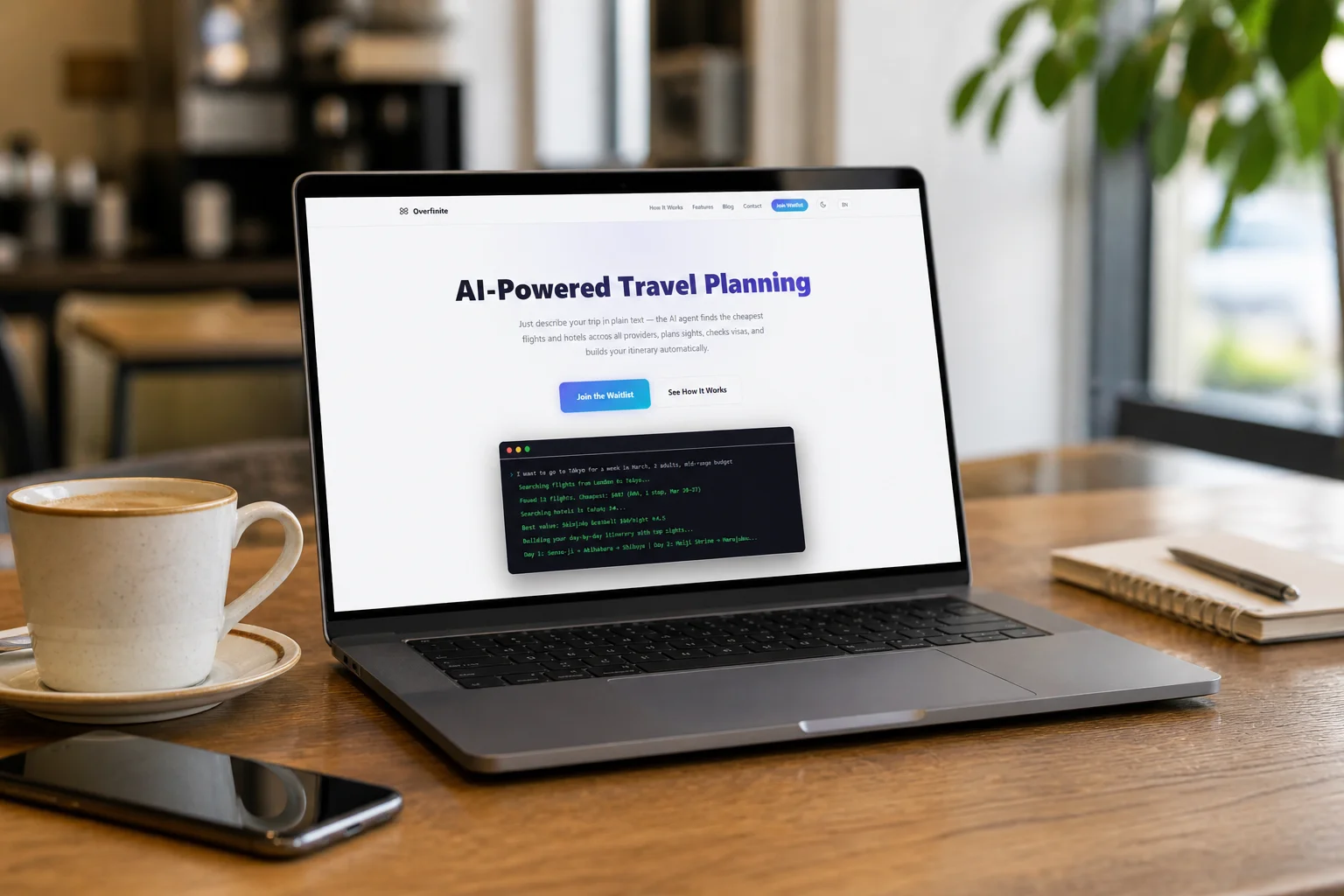
The Overfinite AI travel planner applies exactly this logic — combining destination research, itinerary building, and cost tracking into a single tool built for travellers who want more from their planning than a list of search results.
What AI Can’t Replace
Worth acknowledging: AI travel planning has genuine limits. Complex group logistics, highly specific accessibility requirements, and trips to remote or politically sensitive destinations still benefit from human expertise. The global AI in tourism market was valued at $3.37 billion in 2024 and is projected to reach $13.87 billion by 2030 — growth that reflects both the technology’s expanding capability and its ongoing development. The best tools are improving rapidly, but the gap between AI and an expert human agent narrows on complex itineraries rather than disappearing.
For the majority of trips — independent travel, multi-stop itineraries, city breaks, regional circuits — the AI advantage is already clear enough to make traditional manual planning feel like an unnecessary handicap.
Start Planning Smarter
An AI travel agent doesn’t save money through a single dramatic intervention. It saves through the accumulation of small optimisations — a better booking window here, a smarter routing there, an accommodation choice that saves two hours of daily transit — that compound across a full trip into a materially lower total cost.
Explore Overfinite to see what AI-assisted travel planning looks like in practice, or get in touch with the team if you’d like help planning a specific trip with these tools.
FAQ: AI Travel Agent
A planning tool that uses machine learning and natural language processing to analyse pricing data, travel patterns, and user preferences — producing personalised itineraries, booking recommendations, and cost optimisations automatically.
Yes, primarily through flight timing optimisation, accommodation cross-referencing, and package sequencing — areas where processing large volumes of real-time data gives AI a clear advantage over manual research.
The best tools combine real-time price monitoring, itinerary building, and local knowledge in a single interface. The right choice depends on the type of trip — multi-destination international travel benefits most from tools with strong routing and accommodation matching capabilities.
Yes. AI travel planning tools handle itinerary generation and cost comparison; actual booking still happens through standard secure channels. The main risk is over-relying on AI recommendations without cross-checking critical details like visa requirements and entry conditions.
By simultaneously tracking more variables — pricing windows, routing alternatives, accommodation value relative to itinerary location — than any individual traveller can manage manually, and surfacing the most cost-effective combination rather than the most obvious one.
For standard independent travel, AI is already more efficient. For complex group logistics, highly specific requirements, or unusual destinations, human expertise still adds genuine value. The likely outcome is a hybrid model where AI handles the data-heavy work and human agents focus on cases where nuance and relationships matter.